
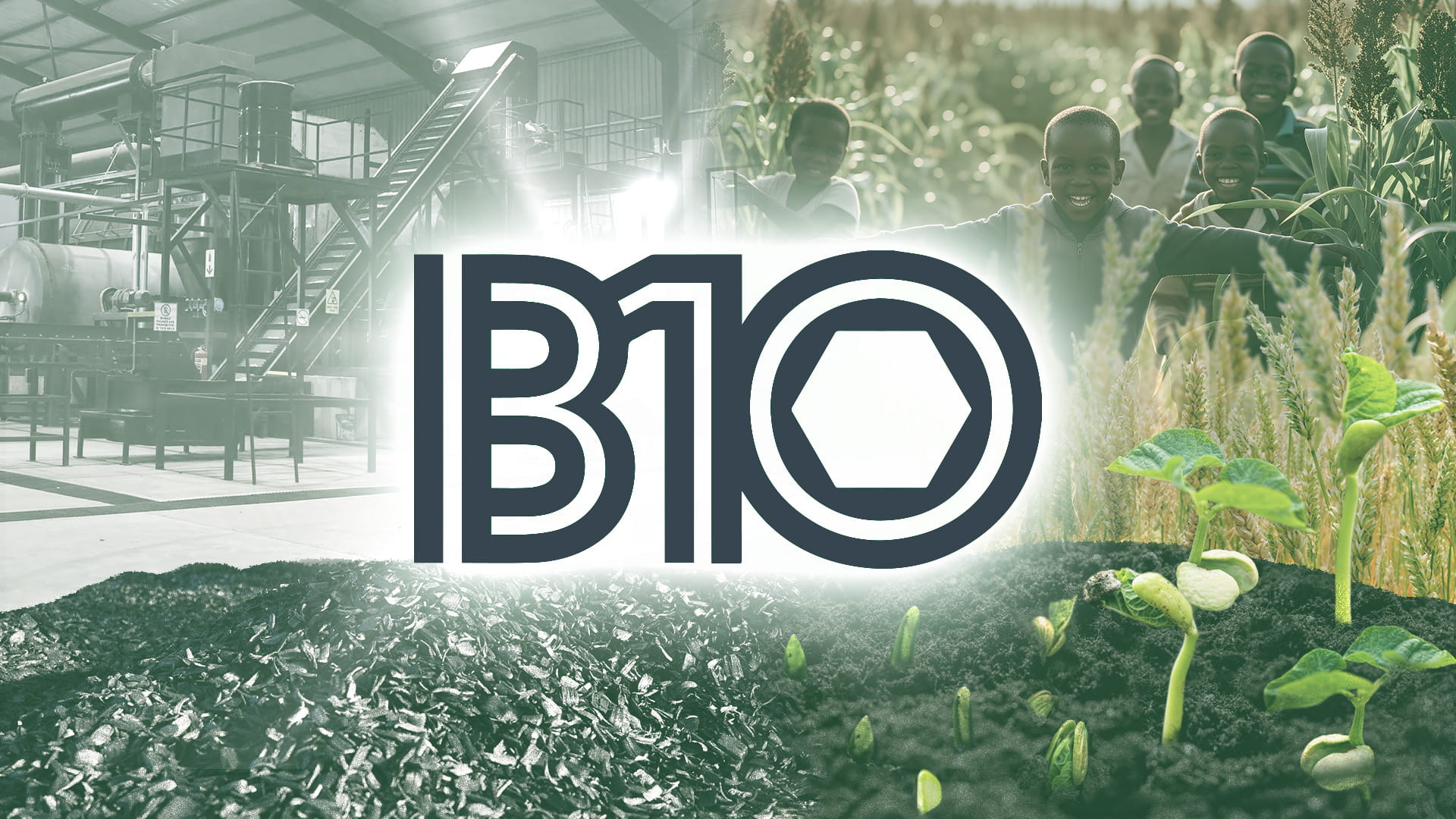
South Africa produces millions of tonnes of waste biomass every year. B10 Char Biochar converts that waste into one of the most stable forms of carbon storage ever discovered — and in doing so, gives local communities, farmers, and the planet a fighting chance.
A million years ago, someone in Wonderwerk Cave in South Africa lit a fire. The charcoal left behind is still intact today. That single fact sits at the heart of everything B10 does.
If ancient charcoal can lock up carbon for a million years, then biochar — a refined, high-purity form of charcoal — might be one of our most powerful tools in the fight against runaway atmospheric CO₂. B10 is betting its entire operation on that premise.
What is biochar — and why does it matter?
Biochar is charcoal produced specifically for use as a soil amendment and carbon sequestration agent. Unlike standard charcoal used for fuel, biochar is engineered for stability and porosity. It can have a carbon content of up to 90% by mass, and once returned to the soil, that carbon stays put — not for decades, but for centuries or millennia.
It’s made through a process called pyrolysis: heating organic material (wood, crop residues, agricultural waste) in a low-oxygen environment at high temperatures.
The result is a highly porous, lightweight black material that transforms how soil holds water, nutrients, and microbial life.
“Biochar is an ancient product whose time has come. The technology is proven, the need is urgent, and the scale of potential impact is enormous.” — B10 Char founding team
A stable, porous form of carbon created from waste biomass via high-heat, low-oxygen pyrolysis. Carbon content up to 90% by mass.
Locks carbon into soil for hundreds to thousands of years, improves water retention, enhances nutrient availability, and boosts crop yields.
The carbon problem biochar is solving
Every living tree is a carbon capture machine. Through photosynthesis, it pulls CO₂ from the air and stores it as wood. That’s free, solar-powered carbon sequestration happening at a planetary scale.
The problem? When that tree dies — whether it rots, burns, or gets converted to compost — most of that stored carbon goes straight back into the atmosphere as CO₂. The natural carbon cycle, operating as designed, is not enough to offset human emissions.
There are billions of tonnes of waste biomass on the planet right now — forestry residues, agricultural waste, invasive wood species — sitting in piles, burning in fields, or slowly decomposing and releasing their carbon.
That represents a staggering missed opportunity.
Tonnes of waste biomass targeted for processing in 2025
Tonnes of CO₂ to be removed from the atmosphere
Tonnes of biochar to be produced
Carbon stability demonstrated by ancient charcoal at Wonderwerk Cave
Reverse coal mining: the B10 philosophy
Every living tree is a carbon capture
The coal industry made its fortune extracting ancient carbon from the earth and burning it — releasing millions of years’ worth of stored CO₂ into the atmosphere in a matter of decades.
B10 does the exact opposite. We call it reverse coal mining.
Instead of digging up ancient carbon and releasing it, we take modern carbon — atmospheric CO₂ already absorbed by trees — and convert it into a stable solid that goes back into the earth. The carbon goes in. It does not come back out.
Through photosynthesis, it pulls CO₂ from the air and stores it as wood. That’s free, solar-powered carbon sequestration happening at a planetary scale.
The problem? When that tree dies — whether it rots, burns, or gets converted to compost — most of that stored carbon goes straight back into the atmosphere as CO₂. The natural carbon cycle, operating as designed, is not enough to offset human emissions.
There are billions of tonnes of waste biomass on the planet right now — forestry residues, agricultural waste, invasive wood species — sitting in piles, burning in fields, or slowly decomposing and releasing their carbon.
That represents a staggering missed opportunity.
Where conventional coal mining extracts carbon and burns it, B10 captures carbon and buries it. Same material, opposite direction, completely different outcome for the atmosphere.
This framing isn’t just conceptual.
It has commercial implications: every tonne of carbon permanently sequestered through biochar can be certified and sold as a verified carbon removal credit — a rapidly growing market that makes the economics of biochar increasingly compelling.
The B10 production process
B10 uses advanced, fully automated continuous kilns — not batch-process or artisan methods. This matters because consistency determines carbon content, and carbon content determines value — both agronomically and as a sequestration asset.
Waste biomass sourcing
Wood chips, forestry residues, and agricultural waste materials that would otherwise burn or rot are collected from local sources.
Pyrolysis in continuous kilns
Biomass is processed at high heat in low-oxygen automated kilns. This converts organic carbon into highly stable biochar with up to 90% carbon content by mass.
Lab testing and quality assurance
Every batch is tested. B10's goal is to be recognised as one of the world's highest-quality biochar producers. No greenwashing. No shortcuts.
Distribution to farmers and the agricultural sector
Available in raw format, wholesale and retail. Early adopters receive incentive programs to experience a full growing cycle before committing.
Why biochar is transforming soil health in Africa
South Africa’s agricultural sector faces a compounding challenge: degraded soils, irregular rainfall, and the rising cost of synthetic inputs. Biochar addresses all three simultaneously.
Water retention
The highly porous structure of biochar acts like a sponge inside the soil matrix. It holds water and nutrients in a way bare soil cannot, reducing irrigation requirements and protecting crops during dry spells — a critical advantage in South Africa’s variable climate.
Nutrient availability
Biochar’s pores create an ideal habitat for soil microbiota. These microbial communities drive the natural nutrient cycles that determine crop productivity. Pre-charged biochar supercharges this effect from day one.
Long-term soil improvement
Unlike synthetic fertilisers that wash out after one season, biochar improves the soil permanently. Applied once, it continues working for decades — lowering the total input cost per crop cycle over time and building genuine soil capital on the farm.
B10’s product specialists guide every farmer through application — the right rate, the right pre-charging method, and the right timing for maximum yield impact.
Social impact: employment and food security
The B10 Way is not only an environmental story. It is a social one.
South Africa’s unemployment rate remains one of the highest in the world, concentrated in the communities that surround the country’s forestry and agricultural regions — the same regions where B10 operates and sources its feedstock.
B10’s model deliberately plants biochar production facilities in areas of high unemployment. Local people are hired and trained on-site. The skills acquired are transferable, the work is permanent rather than seasonal, and the facility becomes a node of economic activity in communities that have historically been bypassed by industrial development.
Beyond employment, B10 donates significant volumes of biochar directly to local communities for food production. A community that can enhance its soil, retain water, and improve yields moves toward food security — and away from dependence on external aid.
Carbon credits and the CDR economy
The world is racing toward net zero, and to get there it needs not just emissions reduction — it needs active Carbon Dioxide Removal (CDR). The scientific consensus is clear: reducing what we emit is not enough. We must physically pull CO₂ back out of the atmosphere.
Trees are nature’s CDR machines. Biochar makes that CDR permanent. When a company or government needs to offset unavoidable emissions through a verified, durable, and measurable removal — biochar is one of very few methodologies that genuinely qualifies.
B10 holds itself to the highest verification standards. The biochar industry has been damaged by greenwashing, and B10’s founders are explicit about their position: transparency is not optional. Every tonne of carbon removed is measured, documented, and verified. Anything less is a disservice to the industry and to the planet.
“In the biochar business, trust is everything. There have been too many examples of greenwashing which have damaged the reputation of our industry. We will hold ourselves to the highest standards.” — B10 founding team
Frequently Asked Questions
Is biochar the same as activated charcoal?
Not exactly. Both are carbon-rich materials produced from organic matter, but activated charcoal undergoes additional processing to maximise surface area for filtration purposes. Biochar is optimised for soil application and long-term carbon stability rather than adsorption. They share structural similarities but serve very different functions.
How long does biochar last in the soil?
High-quality biochar produced through controlled pyrolysis is extremely stable. The ancient charcoal found at Wonderwerk Cave in South Africa — still structurally intact after approximately one million years — is the most dramatic illustration of this. Scientifically, quality biochar is expected to remain stable in soil for centuries to millennia under normal conditions.
Does biochar work on all soil types?
Biochar provides measurable benefits across a wide range of soil types, but the magnitude of the effect varies. Sandy, nutrient-poor, or drought-stressed soils typically see the most dramatic improvements in water retention and crop yield.
Clay-heavy soils benefit primarily from improved aeration and microbial activity. B10 specialists can advise on optimal application rates and methods for specific soil profiles.
What is pre-charged biochar?
Raw biochar is essentially biologically inert when first applied — its pores are empty. Pre-charging involves saturating the biochar with nutrients, typically animal manure or compost, before application.
This “activates” the material and makes its benefits available to plant roots immediately rather than after a period of natural colonisation.
Can biochar be used in organic farming?
Yes, biochar can be used in organic farming and is increasingly recognized for its potential benefits.
How does B10 source its biomass feedstock?
B10 sources waste biomass — materials that would otherwise be burned or left to decay — from the surrounding regions. This includes wood chips, forestry waste, and agricultural residues.
By using material that would otherwise release its carbon naturally, B10 converts a waste problem into a carbon solution. Biomass sourcing is structured through formal supply agreements to ensure consistency and traceability.
Ready to Put Biochar to Work on Your Land?
B10 offers both raw and pre-charged biochar in retail and wholesale quantities, with guided support from our product specialists. Early adopters qualify for incentive pricing to experience a full growing cycle before committing at scale.
